
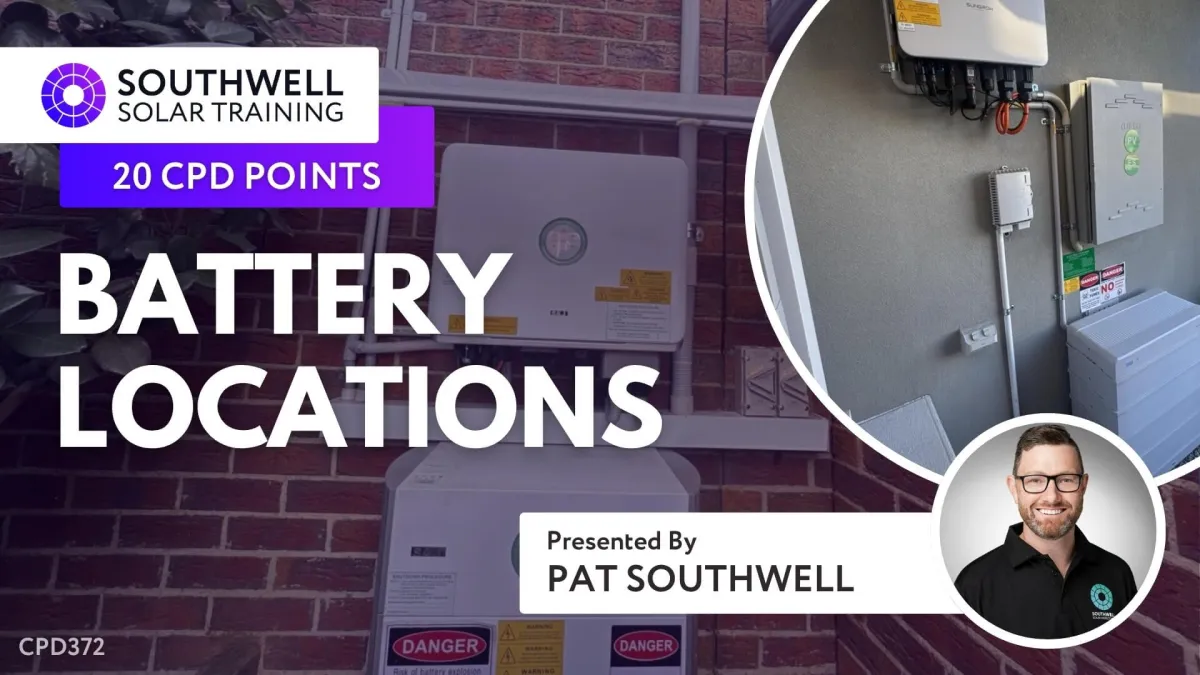
Battery Locations
Getting the location wrong creates fire risk, blocks escape routes, and is one of the quickest ways to end up with a non-compliance. This course breaks down sections 4 and 5 of AS/NZS 5139 into a clear framework you can apply on every install — including the grey areas.
Most installers focus on the electrical side of a battery job. But the standard’s rules on where a battery can and can’t go — and what has to sit between it and a habitable room — are where a lot of systems fall over at inspection. Some of those rules are crystal clear. Others need you to understand the intent and apply it to the house in front of you.
Pat works through the excluded areas and separation distances, the habitable-versus-non-habitable question that causes the most confusion, the non-combustible barrier requirements and which materials actually comply, and the special cases: garages and bollards, battery rooms, egress paths, windows, and environmental conditions. Along the way he points out the defects he sees most often in the field, so it’s something you can use on your next job, not just theory.
What you’ll learn
- Exactly where a battery cannot be installed, and the clearances from windows, vents, appliances and doors
- How to tell a habitable room from a non-habitable one — and why it decides everything
- When a non-combustible barrier is required, how far it must extend, and which materials comply
- The corner rule, the 300 mm off-the-wall option, and why windows are best avoided
- Bollards, battery rooms, egress paths and IP ratings — the details that go beyond the black-and-white rules
Course content
Introduction: why location matters
What can go wrong with a poor location, the sections of AS/NZS 5139 this course covers, and how manufacturer instructions sit alongside the standard.
Excluded areas and separation requirements
The absolute no-go zones, the 600 mm and 900 mm clearances from windows, vents and appliances, and the doorway rule.
Habitable versus non-habitable rooms
What the National Construction Code says, worked examples, and why the wall behind the battery decides whether a barrier is needed.
Barrier requirements and materials
Extents above and beside the battery, ceiling protection, acceptable and unacceptable materials, corners, windows and sealing gaps.
Special installation considerations
Garages and vehicle impact, battery rooms, escape routes and walkways, and environmental conditions including IP ratings.
Wrap-up and knowledge check
The complete framework in one recap, then the quiz to claim your CPD points.
This course includes
- 20 CPD points (SAA accredited)
- 45 minutes of on-demand video
- Certificate of completion
- Battery location checklist
Your presenter
Pat Southwell — Licensed Electrical Inspector
Pat inspects solar and battery installations across Victoria every week as a Licensed Electrical Inspector, with more than 7,000 inspections behind him. He co-hosts the Solar Sidekicks podcast and has trained over 1,000 installers through Southwell Solar Training.