
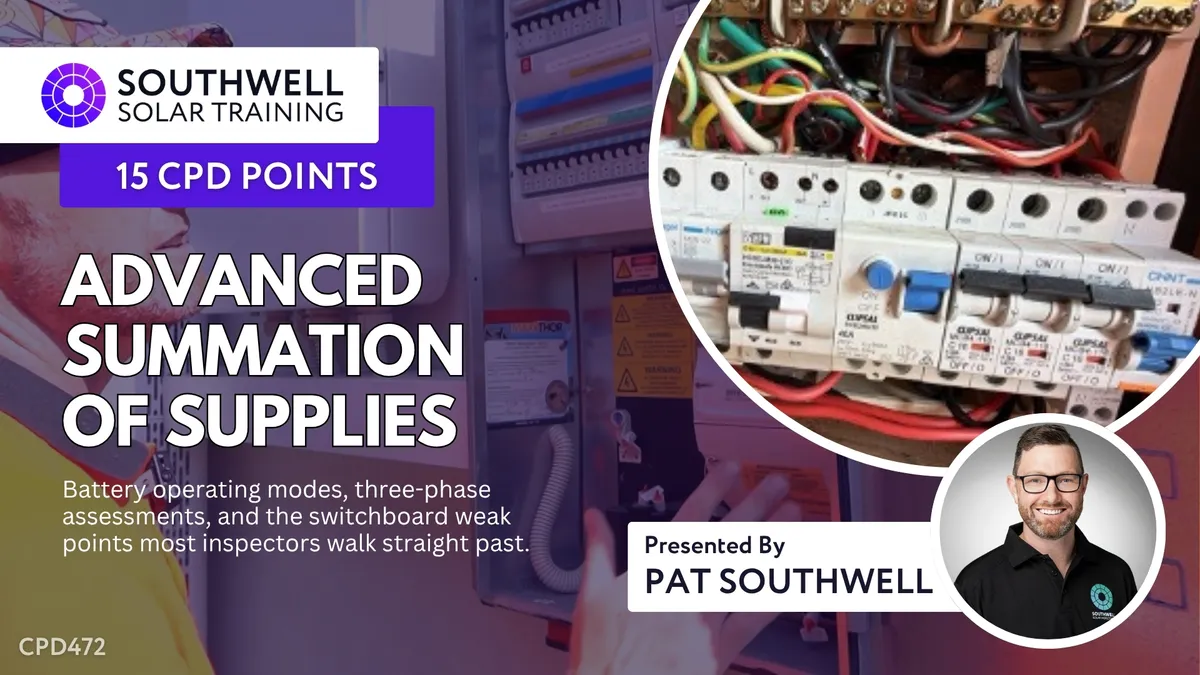
Advanced Summation of Supplies
Add a battery that can run alongside the grid, a second inverter on a three-phase board, or a jumper cable feeding a second DIN rail, and the simple four-step summation check stops being simple. This course takes the method from Introduction to Summation of Supplies and applies it to the installations where it’s hardest to get right — and easiest to walk straight past.
As solar systems get bigger, batteries become common and EV chargers appear on more switchboards, the way current flows through an installation has changed fundamentally. Most of the boards out there were never designed with any of that in mind, and a switchboard that was perfectly compliant before a supplementary supply was added may not be compliant anymore.
Pat works through the three situations that catch people out: a battery that may be supplementary or alternative (and why the answer decides whether it goes into your summation at all), a real three-phase commercial board he inspected alongside a hypothetical one that fails, and the jumper cables, multi-DIN rail boards and neutral links that nobody checks. Every scenario is run through the full four-step process, with the current ratings, the thermal risk inside the enclosure, and what a realistic fix actually looks like.
What you’ll learn
- How to tell a supplementary battery from an alternative one, and which goes into the summation
- Why thermal load inside the enclosure matters even when no component is overloaded
- How to run the four-step assessment on a three-phase commercial switchboard
- How to assess every jumper cable and DIN rail on its own, not just the main switch and busbar
- What to check on neutral links and neutral bars, where nothing trips if they’re overloaded
Course content
Introduction — 2 min
What this course covers, who it’s for, and why it builds on Introduction to Summation of Supplies.
Battery operating modes and the thermal dimension — 4 min
Supplementary versus alternative supply arrangements, the question that decides which one you’re dealing with, and why heat — not just current — is part of every switchboard assessment.
Three-phase assessments — 11 min
A real commercial multi-DIN rail board with two three-phase inverters, run through the four-step process, then a hypothetical board where nobody checked the busbar rating first — and what the remediation options really involve.
Jumper cables and multi-DIN rail switchboards — 23 min
Typical jumper cable ratings, why a second DIN rail needs its own independent assessment, a two-rail and a four-rail worked example, remediation, and the neutral links and neutral bars that have no circuit protection at all.
Conclusion — 1 min
Every retrofit, every EV charger and every bigger system means someone has to ask these questions — and that someone is you.
This course includes
- 15 CPD points (SAA accredited)
- 45 minutes of on-demand video
- Certificate of completion
- Real three-phase and multi-DIN rail switchboard examples
Your presenter
Pat Southwell — Licensed Electrical Inspector
Pat inspects solar and battery installations across Victoria every week as a Licensed Electrical Inspector, with more than 7,000 inspections behind him. He co-hosts the Solar Sidekicks podcast and has trained over 1,000 installers through Southwell Solar Training.